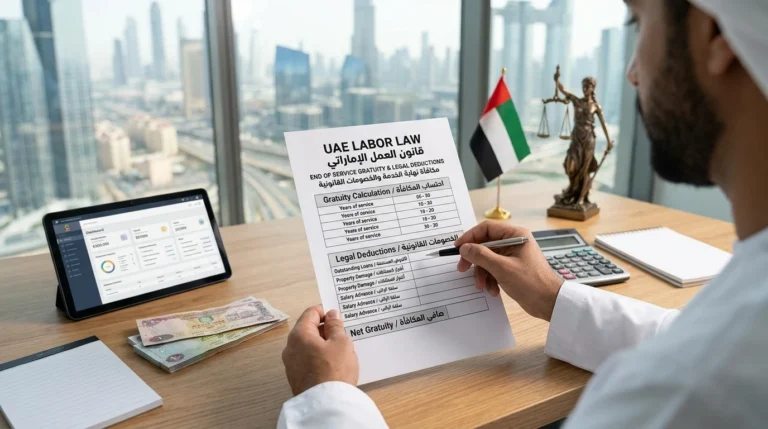
Final Settlement Checklist UAE: What You Must Receive Before You Sign

Your final settlement checklist in the UAE should cover six items: unpaid salary, end-of-service gratuity, unused annual leave pay, notice pay where it applies, unpaid overtime, and any contractual extras such as commission or a return ticket. Your employer must pay all of them within 14 days of your contract end date, under Article 53.
Most disputes start when an employee signs a clearance form before checking the numbers. This guide lists each payment, the law behind it, what an employer may and may not deduct, and a worked example you can hold against your own settlement sheet.
Who this checklist applies to
The checklist covers private-sector employees on the mainland, and in free zones that follow the federal Labour Law, Federal Decree-Law No. 33 of 2021 and its executive regulations (Cabinet Resolution No. 1 of 2022). Three groups follow different rules:
- UAE nationals in the private sector. Their end-of-service benefits come under pension and social security legislation, not Article 51.
- Employees in DIFC and ADGM. They work under their own employment laws and savings schemes.
- Domestic workers, who are covered by a separate law.
The 14-day rule: when the clock starts
Article 53 requires the employer to pay your wages and all other entitlements within 14 days from the end date of the contract. The clock runs from the contract end date, not from the day you submit a resignation letter. If you serve a 60-day notice period, the 14 days begin when that period ends.
Treat this as a deadline you track yourself. Write down your last working day, the contract end date your employer records, and the date the 14 days expire. If payment is late, you can take the matter to MOHRE.
Final settlement checklist UAE: item by item
Tick off each payment below against the sheet your employer gives you. The table shows what each item is based on.
| Component | Basis | Allowances included? | Legal anchor |
|---|---|---|---|
| Unpaid salary | Wage up to your last working day | Yes, full wage | Contract and payroll records |
| Gratuity | 21 days per year (first 5 years), 30 days per year after | No, basic salary only | Article 51 |
| Leave pay | Unused accrued days × daily basic wage | No, basic salary only | Article 29 |
| Notice pay | Wage for the unserved notice period | Commonly yes, full wage | Article 43 |
| Overtime | Hourly basic wage plus 25% or 50% | No, basic wage | Article 19 |
| Commission, bonus, ticket | As written in your contract or policy | Depends on the clause | Employment contract |
1. Unpaid salary
Start with wages for every day you worked up to your last day, including part of the final month. This is normally calculated on your full wage, meaning basic salary plus allowances. Compare your payslips with your salary transfer records so that no month is missing.
2. End-of-service gratuity
Article 51 gives full-time expatriate workers gratuity once they complete one year of continuous service. The rate is 21 days of basic salary for each of the first five years and 30 days for each year after that. A part-year is paid proportionally once the first year is complete. The total cannot exceed two years’ wage, and days of unpaid absence do not count toward your service.
Gratuity uses your last basic salary only, so housing, transport and utility allowances are excluded. Resigning does not reduce it, because the old resignation-based cuts no longer apply under the current law. Part-time workers receive a pro-rata amount based on contracted hours compared with full-time hours (Article 30 of Cabinet Resolution No. 1 of 2022). If your employer enrolled you in the optional end-of-service savings scheme, your settlement includes your savings balance instead of the standard gratuity.
3. Leave encashment
Private-sector employees earn 30 days of paid annual leave for each completed year, and leave accrued in the final incomplete year counts too. Unused days are paid when employment ends, calculated on basic salary. Divide your basic salary by 30 for the daily rate, then multiply by the unused days. For carry-over rules and more examples, read how annual leave pay is calculated.
4. Notice pay
Article 43 sets the notice period at no less than 30 and no more than 90 days, and the same period applies to both sides. The party that breaches the notice period owes the other compensation known as pay in lieu of notice, even if no harm results. If your employer releases you immediately, you should receive pay for the notice period. If you leave before your notice ends, the employer can claim the shortfall from you. Commentary generally calculates this on the full wage, not just basic salary. The notice period rules explain how probation and early release change the position.
No notice or notice pay is due when an employer dismisses a worker for one of the serious-misconduct grounds in Article 44, which requires a written investigation first.
5. Overtime
Normal hours are eight a day or 48 a week. Overtime is capped at two hours a day and must be paid. Ordinary overtime earns the basic hourly wage plus at least 25%. Overtime between 10pm and 4am earns at least 50%, although the night rate does not apply to shift workers. If you worked on your weekly rest day, you are owed either a substitute day off or that day’s wage plus at least 50% of basic wage. Work out the hourly rate as basic salary ÷ 30 ÷ 8. You can check your own hours with the overtime calculator.
6. Commission, bonus, ticket and other contract items
Add anything your contract or company policy promises: earned commission, an agreed bonus, reimbursable expenses, and a return ticket or repatriation costs where the contract provides for them. Attach the relevant clause to each claim so HR can verify it quickly.
What your employer can and cannot deduct
Deductions from gratuity are limited. Under Article 51(7) and Article 29 of Cabinet Resolution No. 1 of 2022, an employer may deduct only these categories:
- Loans, or amounts paid to you in excess of your entitlements.
- Shortfalls in pension and insurance contributions.
- Disciplinary penalties under rules approved by MOHRE.
- Debts owed under a court judgment.
- Damage caused by your mistake or by ignoring the employer’s instructions.
For violations and damage, the employer must act within three months of the amount becoming due, unless otherwise agreed. A UAE legal consultant quoted by Gulf News says recruitment fees, visa and medical costs, uniforms and unexplained “settlement” charges fall outside these categories. Banks are a separate matter: a bank can claim or freeze gratuity to recover a personal loan, but that right comes from your loan contract, not from labour law.
Worked example
The figures below are illustrative, but the formulas follow the rules above. Take an employee with AED 5,000 basic salary and AED 3,000 in allowances (AED 8,000 total wage). She resigns after 3 years, serves the full 30-day notice, and her last working day is the 15th of the month. Her basic daily wage is 5,000 ÷ 30 = AED 166.67, and her full daily wage is 8,000 ÷ 30 = AED 266.67.
| Item | Calculation | Amount (AED) |
|---|---|---|
| Unpaid salary (15 days) | 15 × 266.67 | 4,000.00 |
| Gratuity (3 years) | 21 × 166.67 × 3 | 10,500.00 |
| Unused leave (12 days) | 12 × 166.67 | 2,000.00 |
| Unpaid overtime (24 hours) | 24 × (5,000 ÷ 30 ÷ 8) × 1.25 | 625.00 |
| Less: salary advance | Loan repayment category | −1,500.00 |
| Total settlement | 15,625.00 |
Now change one fact. If she had left 10 days before the notice period ended, the shortfall would be about 10 × 266.67 = AED 2,666.67, bringing the total to AED 12,958.33 if the employer deducts it. Whether notice pay can be taken out of the gratuity itself is worth confirming, because gratuity deductions are limited to the categories above. To test your own figures, use the UAE final settlement calculator.
Before you sign: step-by-step
- 1Ask for a written breakdown. Request every component and every deduction in writing before you sign any clearance document.
- 2Recalculate it yourself. Rebuild gratuity, leave pay and overtime from your basic salary and compare the totals.
- 3Question each deduction. Ask which of the five categories it falls under and request the supporting document.
- 4Hold off on the release. Settlement forms usually say “full and final”. If you must sign a disputed figure, record your objection in writing.
- 5Keep your bank account open. The employer needs an active UAE account to transfer the money.
- 6Keep your records. Save your contract, payslips, salary transfer records, notice letters, leave balance and cancellation papers.
- 7Check unemployment insurance. If you lost your job involuntarily and paid into the ILOE scheme for 12 consecutive months, you have 30 days from the end of employment to claim. Resignation is not covered.
Edge cases that change the numbers
- Less than one year of service: no gratuity is payable, but salary, leave pay and overtime still are.
- Unpaid leave: those days are excluded from your service period, which lowers gratuity.
- Salary cuts near the end: a validly reduced basic wage before termination can lower your gratuity, so read any salary addendum carefully.
- Free zones: most follow the federal rules, but DIFC and ADGM do not. Check which authority regulates your contract.
If your employer misses the 14 days
Go to MOHRE first. It tries to settle the dispute amicably, and for claims up to AED 50,000 it can issue a binding decision. Larger or unresolved claims go to the Labour Court. Prepare a one-page claim listing each amount, payments already received and the net balance. This guide shows how to file a MOHRE complaint over unpaid gratuity.
Do not wait. Under Article 54(9), a claim for rights under the Labour Law cannot be heard after two years from the end of the work relationship. Employees in DIFC or ADGM must use their own regulators, not MOHRE.