Legal Deductions Gratuity UAE: The 5 Categories Explained
The legal deductions gratuity law allows are narrow. Under Article 51(7) of Federal Decree-Law No. 33 of 2021 and Article 29 of Cabinet Resolution No. 1 of 2022, an employer may deduct only five types of amount: loans or overpayments, unpaid pension or insurance contributions, approved disciplinary penalties, court-ordered debts, and damage you caused. Anything else has no legal basis.
Employer deductions usually appear as a line on your settlement sheet, often with no explanation. This guide explains each lawful category, the evidence an employer should hold, the three-month rule, what cannot be deducted, a worked example and how to challenge a wrong deduction.
What the law says
Article 51(7) allows the employer to deduct from end-of-service benefits any amounts payable under the law or a judgment, in line with the conditions in the Implementing Regulation. That regulation is Cabinet Resolution No. 1 of 2022, and its Article 29 sets the closed list. This is Article 29 of the Cabinet Resolution, not Article 29 of the Decree-Law, which deals with annual leave.
A UAE legal consultant quoted by Gulf News explains that deductions work on a category basis. The deduction must fit squarely into one of the five categories and be properly evidenced. The Labour Law also does not set one blanket percentage cap on gratuity deductions, unlike the limits that apply to wage deductions during employment. A deduction with no category or document behind it can be challenged whatever its size.
The five lawful categories
| Category | What it covers | Evidence to ask for |
| 1. Loans or overpayments | Amounts you owe to repay a loan, or amounts paid to you above your entitlements | Loan agreement, payroll record |
| 2. Pension and insurance contributions | Amounts you should have contributed to end-of-service, pension or insurance schemes under UAE legislation | Contribution and payroll records |
| 3. Disciplinary penalties | Penalties for violations under the establishment’s penalty list approved by MOHRE | The approved penalty list, a written record of the violation and the procedure followed |
| 4. Court-ordered debts | Debts owed under a court judgment against you | The court order or execution document |
| 5. Damage you caused | The cost of repairing damage to, or loss of, the employer’s tools, machines, products or materials caused by your mistake or by ignoring instructions | Proof that links the damage to your fault |
A salary advance is the most common example of the first category. A damaged company laptop is the most common example of the fifth, but the employer must prove your fault and follow the correct procedure. A general claim that you “owe” the company something does not qualify.
The three-month rule
Categories three and five come with an extra condition. The employer must have followed the procedures in the Decree-Law and the Resolution, and not more than three months may have passed since the amount fell due, unless you agreed otherwise. If your employer first raises a damage claim six months after the incident, ask why the deadline was not met.
What an employer cannot deduct
Yab Legal’s CEO told Gulf News that recruitment fees, visa and medical costs, uniforms and unexplained “settlement” charges do not fall within Article 29 and cannot be taken from gratuity. Employers also cannot withhold gratuity because there is a dispute, because they are unhappy with your performance or because you resigned.
Notice pay is less clear. An unserved notice period is not one of the five categories, yet employers often net it off the final settlement. Whether that is allowed against the gratuity itself is contested, so ask for the legal basis in writing. The notice period rules explain when notice pay is owed at all.
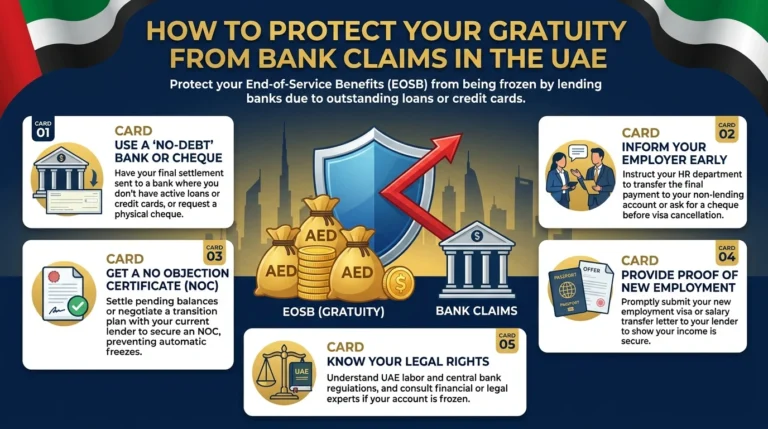
Banks are a separate matter. A bank may claim or freeze gratuity to recover a personal loan, but that right comes from your loan contract, not from the Labour Law. See how banks can freeze gratuity after a loan default.
Common deductions and how they measure up
The table applies the closed list to deductions that employers often try. The last row is an interpretation, because the list does not mention it, so ask your employer which category it relies on.
| Deduction | Likely lawful? | Reason |
| Salary advance or loan balance | Yes | Category 1, with a loan agreement or payroll record |
| Overpaid salary or leave | Yes | Category 1, with proof of the overpayment |
| Damaged or lost company equipment | Possibly | Category 5, only with proof of your fault |
| Recruitment, visa or medical costs | No | Outside Article 29, according to Yab Legal |
| Uniform costs | No | Outside Article 29, according to Yab Legal |
| Training bond or air ticket recovery | Unclear | Not listed, so ask which category applies and which contract clause |
A lawful deduction should be traceable on paper. Look for an itemised line, the category it relies on, the supporting document and the date the amount fell due. If any of these is missing, treat the deduction as unproven until the employer supplies it.
Worked example
Take an illustrative employee with a basic salary of AED 6,000 and four years of service. Gratuity is 6,000 ÷ 30 × 21 × 4 = AED 16,800. The settlement sheet shows these deductions:
| Deduction | Amount (AED) | Category | Lawful? |
| Salary advance | 2,000 | Loans or overpayments | Yes, if documented |
| Visa renewal cost | 1,500 | None | No |
| Damaged laptop | 3,000 | Damage you caused | Only if fault is proven and the three-month rule is met |
| “Settlement charge” | 500 | None | No |
| Total deducted by employer | 7,000 |
The employer’s sheet pays out AED 9,800 (16,800 − 7,000). If only the advance is lawful, the correct payment is AED 14,800. If the laptop deduction is also properly proven, it is AED 11,800. Either way, the employee is owed at least AED 2,000 more than the sheet shows. The same method applies to any settlement.
How to challenge a wrong deduction
- Ask for a written breakdown. Request the category and supporting document for every deduction.
- Check the dates. For penalties and damage, confirm the employer acted within three months and followed the required procedure.
- Recalculate your gratuity. Use basic salary only and compare the net with the sheet. The final settlement calculator helps with the full settlement.
- Do not sign an unqualified release. If you must sign, write your objection on the document, because a clean signature can weaken your position later.
- Send a written demand. State the figure you believe is correct, using this sample demand letter as a guide.
- Go to MOHRE. MOHRE attempts an amicable settlement and can issue a binding decision on claims up to AED 50,000. Our guide shows how to file a MOHRE complaint.
Time limits and jurisdiction
Article 54(9) bars a claim for rights under the Decree-Law, including gratuity, after two years from the end of the work relationship, so raise a wrong deduction promptly. Employees in DIFC or ADGM follow different frameworks and should not use MOHRE. The right authority depends on where your contract is registered.
Edge cases
- Resignation: the deduction rules are the same whether you resigned or were terminated, and resigning does not reduce your gratuity under the current law.
- Partial disputes: if only one deduction is disputed, you can ask for the undisputed balance to be paid on time while you challenge the rest in writing.
- Mixed settlement sheets: final salary, leave pay and gratuity often appear together. Ask for separate lines, because the rules for deducting from wages during employment differ from the rules for gratuity.
- Less than one year of service: no gratuity is payable, so there is nothing to deduct from. Other final dues remain separate.
Key takeaways
- Only five categories of deduction are lawful, and each needs supporting evidence.
- Deductions for penalties and damage must meet the procedure and three-month conditions.
- Recruitment, visa, medical, uniform and unexplained settlement charges are not lawful deductions.
- Ask for a written breakdown, avoid unqualified releases and challenge errors through MOHRE within two years.