Grace Period After Visa Cancellation in the UAE: How Many Days You Get

The grace period visa cancellation rules depend on your emirate and residence category. ICP gives 30 days for most categories, 60 for guarantor or host permits, 90 for skilled levels 1–3 and property owners, and 180 for Golden, Green and Blue residence holders. GDRFA Dubai states 60 days. Overstaying costs AED 50 per day.
Visa cancellation usually follows the end of a job, so the grace period overlaps with your final settlement. Your employer must pay wages and other entitlements within 14 days of the contract end date under Article 53, and gratuity under Article 51 is part of that payment. This guide explains the periods, when the clock starts and what to do before it runs out.
How long is the grace period?
The answer depends on who issued your residence and which category it falls under. The table summarises the official figures:
| Authority and category | Grace period | Notes |
| ICP: Golden, Green and Blue residence holders and their families; widows or divorced women of residents; students after studies; foreign-passport relatives of UAE citizens | 180 days | Longest published period |
| ICP: skilled workers in levels 1–3; property owners | 90 days | Earlier reports said levels 1 and 2 get 180 days; ICP’s current page lists 90 for levels 1–3 |
| ICP: permits issued with a guarantor or host | 60 days | Check how your permit is recorded |
| ICP: all other categories | 30 days | The shortest published period |
| GDRFA Dubai: cancellation of all types of residence permits | 60 days | Stated on GDRFA’s general service page |
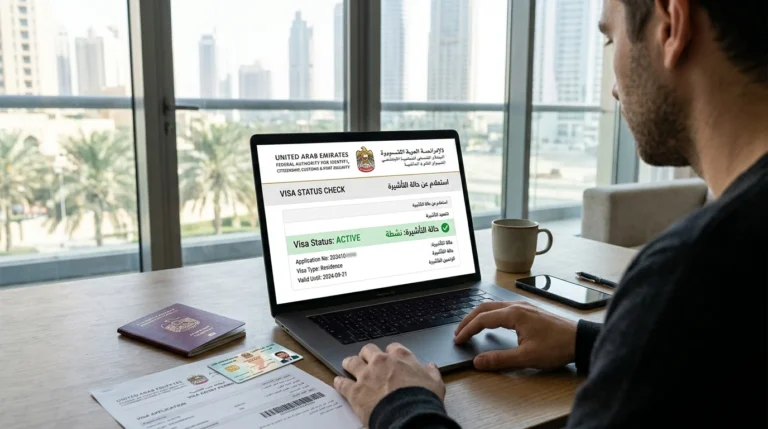
Secondary guides disagree about where ordinary employees fit. Some put them in ICP’s 30-day group and others in the 60-day group. A lawyer quoted by Gulf News also says grace periods are applied at the authorities’ discretion after reviewing the cancellation. The reliable answer is the date recorded in your own file. Check it in the ICP Smart Services portal with UAE Pass, or with GDRFA Dubai if your visa was issued in Dubai.
When the grace period starts
ICP counts the grace period from the expiry or cancellation of the residence permit. Practitioners add a catch for mainland employees: Fragomen’s Shayan Sultan told Gulf News that the period starts from the date the labour card is cancelled, while free zone employees count from the residence permit cancellation. Because the MOHRE cancellation comes first, treat it as your starting point. Our labour card guide explains that step.
Here is an illustrative timeline for a mainland employee on a 30-day period. The contract ends on 30 November, MOHRE cancels the work permit on 1 December, and the residence is cancelled on 3 December. Counting from 1 December, day 30 is 31 December. Counting from 3 December, it is 2 January. Plan around 31 December and leave a margin. On a 60-day period, the earlier count ends on 30 January. The employer’s payment deadline under Article 53 would be 14 December, which falls well inside the grace period.
What you can do during the grace period
- Leave the UAE before the period ends. No fine applies if you exit in time.
- Move to a new employer. The new employer applies for a work permit and residence visa. You can change status inside the country through an Amer centre or authorised typing centre, and a lawyer quoted by Gulf News puts the cost at roughly AED 550 to AED 650.
- Switch to another sponsor. A family member can sponsor you, or you can apply for a self-sponsored visa such as the Green Visa if you qualify.
- Apply for a job-search permit. The UAE offers an entry permit for job seekers valid for 60, 90 or 120 days. The same lawyer says it requires a degree from a recognised university and a financial guarantee.
- Convert to a visit status. Some residents can change to a visit visa without leaving, which adds 30 to 90 days but gives no right to work. Confirm that your file allows it before you rely on it.
Is there a grace period on a tourist visa?
No. Tourist and visit visas have no grace period. The 10-day allowance Dubai once gave was removed in 2023, and ICP confirmed to The National that overstay fines start immediately after expiry. The fine is AED 50 per day. If you need more time, apply for an extension before the visa expires.
Do not confuse this with the visit status a former resident may obtain during a residence grace period. That is a new status with its own expiry date, not an extension of the old grace period.
Overstay fines
ICP applies a fine of AED 50 per day for staying in the UAE starting from the day after the grace period of your residence permit ends. For example, a 30-day grace period that ends on 31 December means the first fine applies on 1 January, and 10 days of overstay cost AED 500.
Visa cancellation and your final settlement
Cancellation does not cancel your right to be paid. Gratuity under Article 51 is 21 days of basic salary for each of the first five years and 30 days for each year after that, and the employer must pay it with your other dues within 14 days of the contract end date. Use the final settlement calculator to check the figure before you sign the cancellation papers.
Your signature is normally required on the cancellation application, so sign it, but check that nothing in the paperwork states that all dues have been received. If your payment is late, act while the grace period is still running. Published guidance does not say that a pending labour complaint extends the grace period, so plan around the published deadline and ask MOHRE or ICP about your file.
If the employer has not paid, here is how to file a MOHRE complaint. Under Ministerial Resolution No. 47 of 2022, as reported by Gulf News, a worker whose case is referred to the Labour Court may apply for a temporary work permit, unless the employer has declared the worker absconding.
Step by step: protect your status after cancellation
- Get both cancellation records. Obtain proof of the MOHRE work permit cancellation and the residence cancellation, and note both dates.
- Confirm your grace period. Check the end date in ICP Smart Services or with GDRFA Dubai, and write down your own safe date a few days earlier.
- Get the settlement date in writing. Ask HR for a breakdown of every payment and the date it will be transferred.
- Choose your route. Decide whether to leave, join a new employer, change sponsor or apply for a job-search permit.
- File status changes early. A new employer needs time to process the entry permit and change of status, so do not leave it to the last week.
- Check your insurance. Gulf News has reported that health insurance may not last for the whole grace period, so confirm when your cover ends.
Edge cases
- Dependants: ICP says family permits under a worker’s sponsorship must be cancelled before the worker’s own residence, or placed on hold for a limited period with fees.
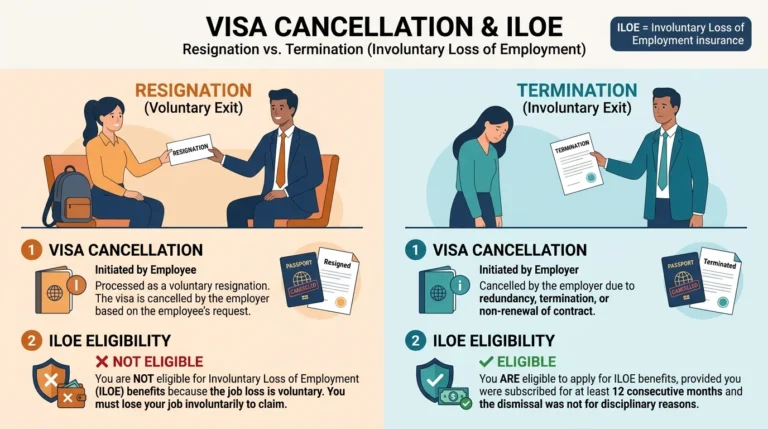
- Involuntary job loss: if you lost your job through no fault of your own, check whether you can claim under the workers insurance scheme. The claim window is short, so act within days, not weeks.
- Notice period: the grace period starts only after employment ends, not when you resign. Read the notice period rules to see when cancellation will actually happen.
- Dubai versus other emirates: do not apply ICP’s table to a Dubai-issued visa without checking GDRFA’s published period.