Abu Dhabi Labour Court Gratuity Award: How Courts Decide and What to Expect

An Abu Dhabi labour court gratuity award follows the same formula as a MOHRE settlement: 21 days’ basic wage for each of the first five years and 30 days for each year after, capped at two years’ basic wage. Recent rulings show what decides these cases: proof of service, the basic salary used and documented acknowledgement of the amount owed.
This article uses 2025–2026 first-instance rulings reported in the UAE press to show how a court award is reached. It covers mainland private-sector employees in Abu Dhabi. Press reports describe individual judgments. They do not create new law or change the gratuity formula, and some reports omit details such as the basic salary.
How a Gratuity Claim Reaches the Labour Court
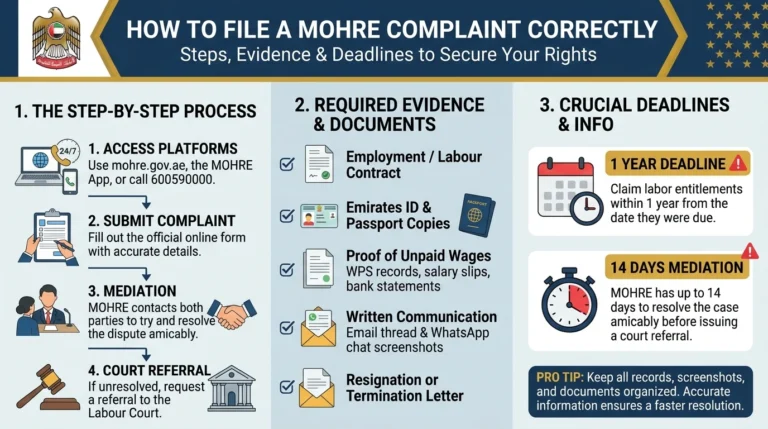
A gratuity dispute goes to MOHRE first. The labour court hears it only if MOHRE cannot settle it and the claim is above the ministry’s limit.
Under the government’s labour dispute guidance, MOHRE has 14 days from the application to try to settle the dispute. If that fails, claims above AED 50,000 are referred to court with a memorandum summarising both sides’ arguments. For claims of AED 50,000 or less, MOHRE can issue a final decision itself. Our guide explains how the AED 50,000 MOHRE threshold works.
| Claim value | Who decides | Practical effect |
| AED 50,000 or less | MOHRE can issue a final decision if no settlement is reached. | Many gratuity-only claims never reach court. |
| Above AED 50,000 | MOHRE refers the case to the competent labour court. | You register the court case promptly after referral. |
Three points from the same guidance affect timing and cost. No claim is heard after one year from the date of the violation, so read our note on the time limit for a gratuity claim before waiting. Workers are exempt from judicial fees at all stages for claims under AED 100,000. A worker who keeps working for the employer while the case is in court may claim two months’ wages, and the work permit is cancelled six months after referral if the worker stops work.
What the Court Applies Under Article 51
Courts apply Article 51 of Federal Decree-Law No. 33 of 2021: gratuity after one year of continuous service, calculated on the last basic salary.
In a January 2026 Abu Dhabi ruling, the court explained that foreign workers receive gratuity when employment ends for any reason after one year of continuous full-time service. It also said the total cannot exceed 24 months of the most recent basic salary. Another 2026 ruling summarised the rate as 21 working days per year for the first five years and 30 days for each year after.
Illustrative example: an employee with AED 6,000 basic monthly salary and 12 years of service.
- Years 1–5: 5 × 21 = 105 days.
- Years 6–12: 7 × 30 = 210 days.
- Total: 315 days. Daily wage is AED 6,000 ÷ 30 = AED 200.
- Gratuity: 315 × AED 200 = AED 63,000. The cap is 24 × AED 6,000 = AED 144,000, so it does not apply.
The cap does bite for very long service. In a reported case, a worker with 31 years and six months of service earned AED 3,900 basic salary. The standard formula produced AED 116,350, but the court limited the award to AED 93,600, which is two years of basic salary. You can test your own figures with the gratuity calculator for Abu Dhabi.
What a Court Award Usually Includes
A court award often covers more than gratuity. In a reported Abu Dhabi case after 16 years of service, the total award was AED 427,337. It was made up of AED 360,119 in gratuity, AED 35,452 in notice pay and AED 31,766 for unused leave, and the company also had to pay legal fees and costs in proportion to the award.
Reported 2026 judgments also describe awards as immediately enforceable without a bond. Appeals can still change the figure: in a March 2026 report, the Abu Dhabi Labour Court of Appeals cut an award from AED 898,026.9 to AED 203,880 for an employee with 22 years of service.
Why Documented Acknowledgement Matters
When an employer admits a specific amount in writing or in the proceedings, the court has less to decide. Documented acknowledgement does not guarantee the full claim, but it narrows the dispute.
In a case reported on 13 October 2026, the employer acknowledged liability for AED 160,356 in gratuity and AED 6,152 in leave pay after 15 years of service, and disputed other claims. The court ordered AED 187,711 overall. The report gives no breakdown of the difference, so it should not be read as a rule about how courts treat admissions.
In a September 2026 case, the court recorded that the defendant had acknowledged the employee’s entitlement to gratuity, using the same 21-day and 30-day rates, and upheld the request. In practice, emails, settlement statements and HR letters that state an amount can become part of the evidence. Be careful before signing an “all dues received” form, because a broad receipt can work against you.
Proof of Payment and Other Evidence
Courts in these reports put heavy weight on documents. In a September 2026 ruling, the court found no evidence that the employer had paid 12 months of wages, and the report says employers cannot avoid wage obligations without written evidence. In a November 2026 report, a company ordered to pay AED 316,333 had not provided proof that the dues were paid. That award included gratuity of AED 74,833 for 13 years, 11 months and 20 days of service.
Abandonment arguments also need proof. In one case, the employer said the worker stopped reporting, but admitted it took no formal legal steps over the absence, and the court found the claim valid. In another, the court noted the company failed to prove the employee abandoned his job, and upheld the gratuity. Where the amount is disputed, the court may rely on an expert. In an October 2026 ruling, the court adopted an expert calculation of AED 93,386 based on length of service and basic salary.
Keep these before you file:
- Employment contract, offer letter and any contract amendments.
- Payslips, bank statements and WPS records showing the basic salary.
- Dated proof of your start and end dates, such as the cancellation record.
- Leave records and any written statement of amounts the employer owes.
Edge Cases From Recent Rulings
- Resignation after unpaid wages: In a reported case, an employee with 22 years of service resigned after the company failed to pay wages and gratuity. The court ordered AED 289,265 in wages and end-of-service benefits.
- Disputed basic salary: A reported ruling states that if the contract does not specify the amount or type of remuneration, the competent court determines it. Keep your contract and payslips so the basic wage is not left to argument.
- Dismissal without dues: Several reports involve employees dismissed after 13 to 21 years who received none of their entitlements, and the courts ordered payment.
- ADGM and DIFC: These jurisdictions have their own employment rules and courts. Read the ADGM and DIFC end-of-service rules instead of assuming the mainland process applies.
Steps to Take Before and During a Claim
- Work out your gratuity from your last basic salary and exact service dates.
- Collect the documents listed above before your access to company systems ends.
- File a complaint with MOHRE within one year of the violation, and attend the mediation.
- Save any written offer or admission of an amount, and keep it separate from the disputed items.
- If MOHRE refers the case, register it in court promptly and keep your referral papers.
- Ask the court for costs. Reported judgments often order the company to pay legal fees and expenses in proportion to the award.