How to File a MOHRE Complaint Correctly: Steps, Evidence and Deadlines
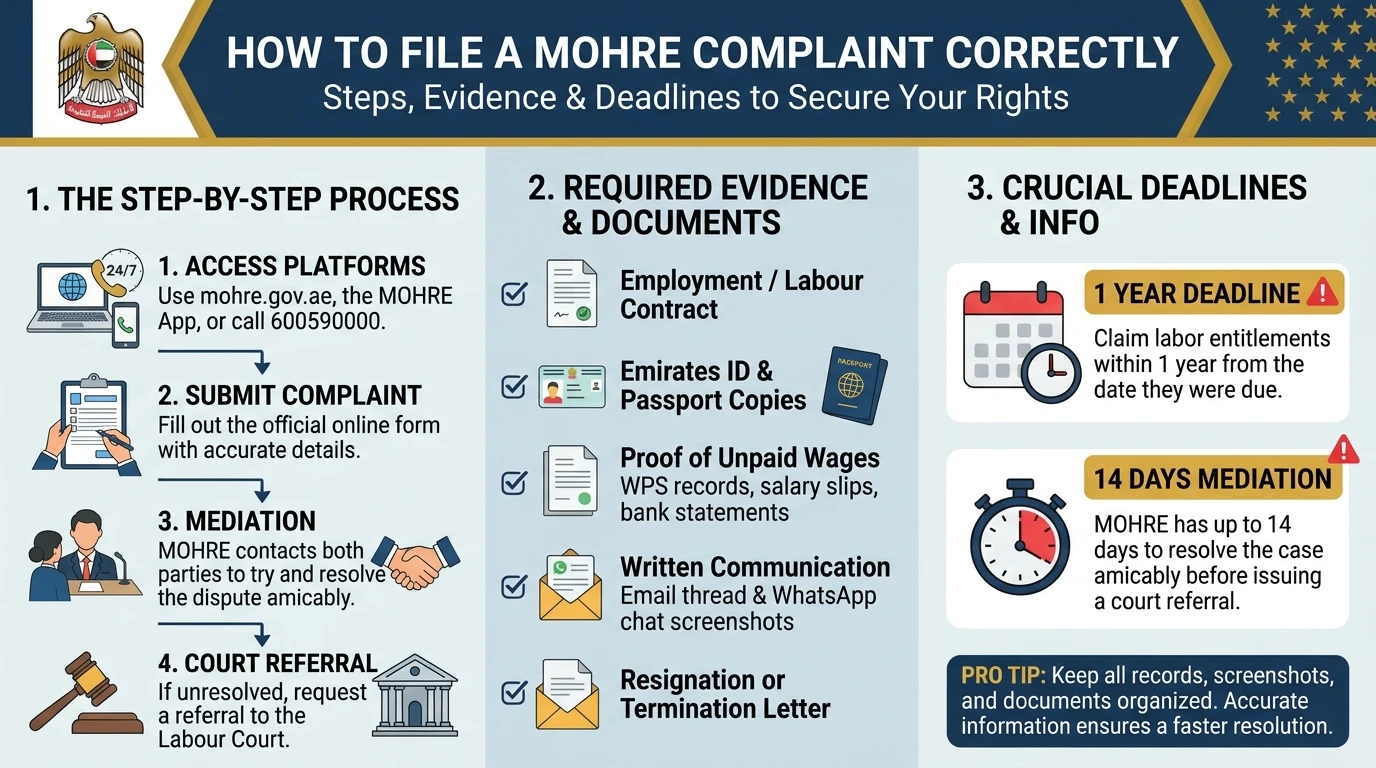
Here is how to file a MOHRE complaint: register it on the MOHRE app or website, or call the Labour Claims and Advisory hotline on 80084. You need your work permit and passport numbers. MOHRE contacts both sides, tries to settle within 14 days, can decide claims up to AED 50,000, and refers larger or unresolved cases to court.
This guide covers private-sector employees on the mainland. Free zone employees usually try their free zone’s mediation route first, and DIFC and ADGM have their own courts. Domestic workers can also use MOHRE, but a separate law governs their employment.
When a MOHRE Complaint Is the Right Step
File when your employer has broken the law or your contract and a direct request has failed. Typical grounds are unpaid or delayed wages, unpaid leave or overtime, withheld documents such as your passport, wrongful termination and unpaid end-of-service dues.
Gratuity claims are among the most common. Under Article 51(2), a full-time expatriate employee with at least one year of continuous service is entitled to gratuity, and Article 53 requires the employer to pay all dues within 14 days of the contract ending. If that deadline has passed, you can file. Our guide to claiming unpaid gratuity explains how that dispute usually unfolds.
Before You File: Information and Evidence
The complaint process is mostly mediation, and MOHRE needs only identifying numbers to register. Your evidence decides how strong the case is when the employer disputes your figures.
Information Required to Register
- Employees: your work permit number and passport number.
- Employers: the establishment number.
Evidence Worth Collecting
MOHRE does not list documents as a condition for filing. The items below are practical advice, and they help in mediation and in court.
- Your employment contract and offer letter, plus any amendments.
- Payslips and salary bank statements, which show what you were actually paid.
- Your resignation or termination letter and any notice you gave or received.
- Emails and messages with your employer about the money you are owed.
- Attendance and leave records, and any final settlement statement or clearance form.
Salary transfers made through the Wage Protection System records leave a bank trail, which makes unpaid-wage claims easier to prove. Keep copies on your own phone or email, because you may lose access to company systems when you leave.
A dated written request also helps. It shows the employer had a chance to pay, and it fixes the amount you are claiming. Our written demand letter gives you wording to adapt, although MOHRE does not require one.
How to File a MOHRE Complaint Step by Step
The process below follows MOHRE’s own steps for private-sector employees.
- Check your route. Mainland employees go straight to MOHRE. If your employer is licensed in a free zone, ask the free zone authority whether you must use its mediation first.
- Choose a channel. Use the MOHRE app, the MOHRE website or the call centre. The table after these steps lists the numbers.
- Enter your details and describe the claim. State each item separately, with the period and amount, such as unpaid wages for 10 days or gratuity for four years. Vague claims slow mediation.
- Submit and keep the reference number. Both you and your employer receive an SMS with the complaint reference and an invitation to settle. Use the number to track progress in the app or on the website.
- Answer MOHRE’s call. A Ministry representative contacts the parties within 14 days of registration, usually by phone or video. A complaint can be closed if you do not respond in time.
- Learn the outcome. The result depends on whether the parties settle and on the claim value, as the second table shows.
- Act on the decision. You have 15 working days to appeal a MOHRE decision to the Court of Appeal. If the case goes to court, file it within 14 days of the referral date.
Hotline Numbers and Channels
| Channel | Number or access | Use it for |
| Labour Claims and Advisory Call Centre | 80084 (toll-free) | Advice, filing and withdrawing a complaint |
| MOHRE call centre | 80060 | Registering a complaint by phone |
| MOHRE contact centre | 600590000 | General enquiries and complaints by UAE citizens |
| MOHRE app and website | Sign in with UAE Pass | Filing and tracking by reference number |
Check the MOHRE website for the current numbers before you call, because contact details change.
What MOHRE Can Decide
| Outcome | When it applies | Effect |
| Amicable settlement | Any claim value | Binding on both sides |
| Final MOHRE decision | Claim up to AED 50,000 and no settlement | Enforceable like a court order; appeal within 15 working days |
| Court referral | Claim above AED 50,000 and no settlement | File the case within 14 days of the referral date |
A final MOHRE decision carries the force of an execution writ, but a timely appeal suspends it until the court rules. Court filings must be in Arabic, so documents in other languages need translation by an approved translator. Workers are exempt from court fees for claims under AED 100,000 under Article 55.
Deadlines and Time Limits
- Filing deadline: two years from the date the right became due, under Article 54(9), following the 2024 amendment.
- MOHRE’s first contact: within 14 days of registration.
- Appeal: 15 working days from notification of the decision.
- Work permit cancellation after a final decision: request it within 60 days of notification, unless the employment continues.
- Court filing after referral: 14 days from the referral date.
What Happens to Your Job and Wages During a Complaint
If you are still employed, a dismissal that follows a genuine complaint can itself be challenged as arbitrary. Our guide to arbitrary dismissal claims explains when compensation applies.
If the dispute stopped your pay, MOHRE can direct the employer to keep paying wages for up to two months. If the case goes to court and you keep working, you may claim wages for up to two months.
During the complaint, MOHRE may allow a temporary work permit for a new employer. If you stop working and the case is referred to court, your original work permit is cancelled six months after the referral.
Worked Example: An Unpaid Gratuity Claim
These figures are illustrations. The entitlement rules and deadlines are legal; the salary and service details are assumed.
An employee resigns after four years of service. Basic salary is AED 7,000 and total pay is AED 10,000. Ten days of wages and eight days of leave are unpaid, and the employer misses the 14-day deadline.
- Gratuity: 4 × 21 = 84 days; AED 7,000 ÷ 30 × 84 = AED 19,600
- Unpaid wages: AED 10,000 ÷ 30 × 10 = AED 3,333.33
- Unused leave on basic salary: AED 7,000 ÷ 30 × 8 = AED 1,866.67
- Total claim: AED 24,800
The employee registers one complaint listing all three items and checks the figures with our dues calculator first. Because AED 24,800 is below AED 50,000, MOHRE can issue a binding decision if the employer refuses to settle.
Common Mistakes That Weaken a Complaint
- Filing in the wrong place. Free zone and DIFC or ADGM employees may need a different first step.
- Waiting too long. The two-year limit is firm, and evidence fades sooner.
- Leaving the claim vague. List each item, period and amount.
- Signing a full-payment form early. A clearance form saying you received everything can undercut your claim, so sign only after the money arrives.
- Missing MOHRE’s call. An unanswered complaint can be closed.
- Missing the appeal or court deadline. The 15-working-day and 14-day windows are short.
Key Takeaways
- Register through the MOHRE app, website or call centre, or call 80084 for advice.
- You need your work permit and passport numbers; evidence is not required to file but strengthens the case.
- MOHRE contacts both sides within 14 days and can decide claims up to AED 50,000.
- Claims above AED 50,000, or unresolved free zone cases, go to court.
- File within two years, appeal within 15 working days, and keep your reference number through every stage of the process.
This guide gives general information for private-sector employees and is not legal advice.