How to Protect Your Gratuity from Bank Claims in the UAE
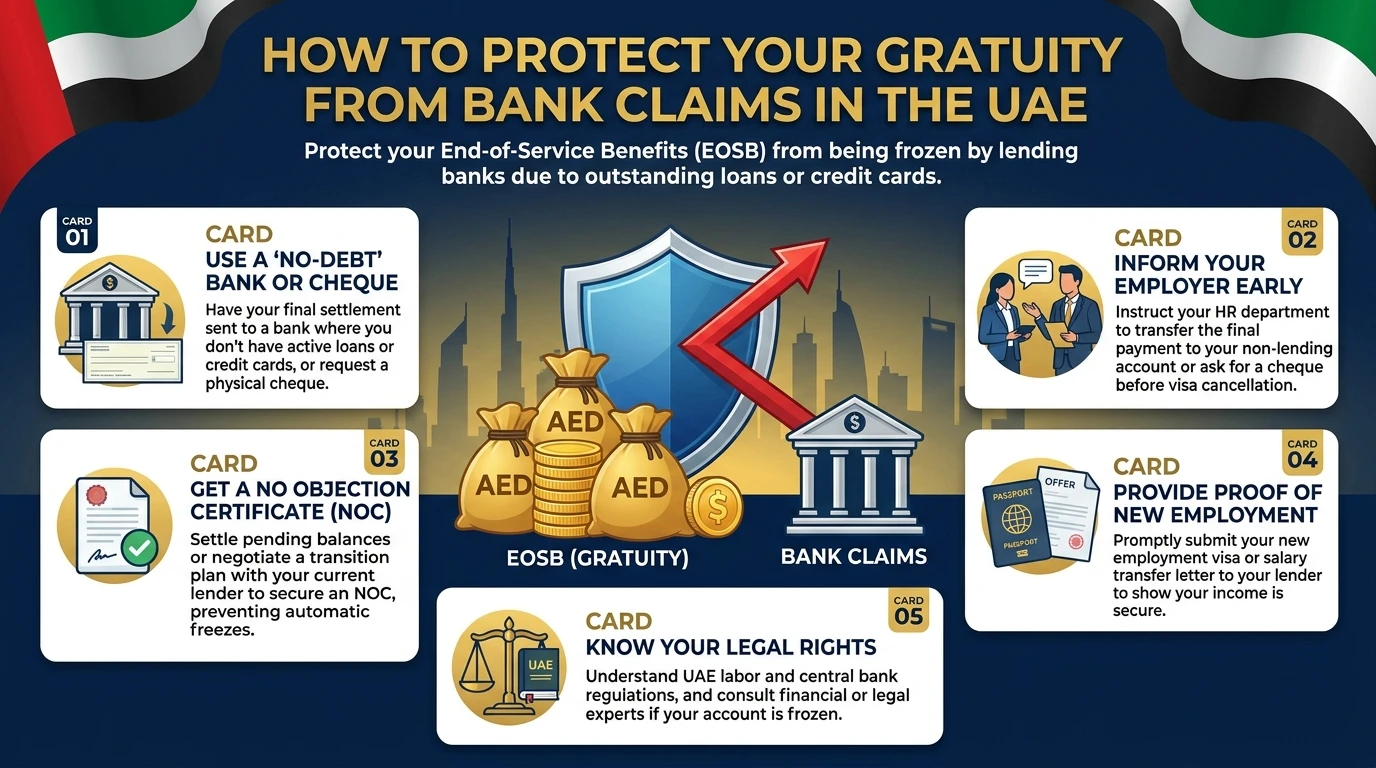
To protect gratuity from bank claims, check your loan agreement first, because a bank’s right comes from that contract, not the Labour Law. Tell the bank before your last day, clear or restructure the debt if you can, and know the limits: a bank cannot block more than you owe or use your gratuity for a mortgage.
No step switches off a valid loan clause, so the aim is practical. Avoid a freeze you can prevent, limit any hold to what you actually owe, and challenge anything beyond that. This guide covers where a bank’s claim comes from, the Central Bank limits, a plan to follow before you resign, and what to do if your salary account is blocked.
Where a Bank’s Claim on Your Gratuity Comes From
The claim does not come from the Labour Law. Article 51 of Federal Decree-Law No. 33 of 2021 sets how much gratuity you earn, and Article 53 requires your employer to pay it within 14 days of the contract end date. Article 51(7) lets the employer deduct only amounts due by law or under a court judgment. A lawyer quoted by Gulf News in November 2026 made the same point: any right a bank has comes from the loan agreement you signed.
That agreement is usually based on the Central Bank-approved personal loan format. Under it, you give the bank a letter from your employer undertaking to transfer your salary and end-of-service benefits to the bank for the life of the loan. The same format lets the bank demand the full balance if it sees grounds that you may be unable to repay, and ending your job is the usual example. Our guide explains what triggers a freeze or full repayment demand.
The hold usually lands on your salary account because that is where the gratuity arrives, but it is not limited to it. Lawyers quoted by Gulf News in 2024 said a bank can generally offset what you owe against funds in any account you hold with it. A salary account carries no special protection.
What a Bank Cannot Do
A bank can block funds only for listed reasons, only up to what you owe, and never from your end-of-service payment to cover a mortgage. These limits come from the Central Bank’s Consumer Protection Standards, which apply to retail accounts.
| Rule | What it means for you |
| A listed ground is required | Recovering money owed on credit facilities or unpaid fees is one ground. Others include a court order, a Central Bank instruction, proven dishonesty and the customer’s death. |
| Written notice within 24 hours | The notice must give the details of the block, what you are expected to do and who to contact. A narrow exception covers financial crime risk. |
| No over-blocking | The bank cannot block more than the outstanding liability at the time of the block. |
| No mortgage claims on gratuity | End-of-service funds cannot be blocked to repay a mortgage loan or financing. |
| No penalty fees during a block | Fees that would overdraw the account, including returned cheque fees caused by the block, wait until the block is lifted. |
A clause in your loan agreement does not override these rules. The same Gulf News commentary drew a useful line: holding your gratuity as security and using it to repay the loan are separate actions, and each needs its own justification. A borrower who keeps paying on time may therefore have a case for release, even though the bank can freeze the account as a precaution.
How to Protect Your Gratuity Before You Resign
- Read the loan agreement and your employer’s letter. Look for the salary and end-of-service assignment clause, the events that make the balance due, and any rule about moving your salary. Ask the bank for a full loan statement so you know the exact balance.
- Estimate your gratuity. Under Article 51, a full-time foreign worker with at least one year of continuous service earns 21 days of basic wage for each of the first five years and 30 days for each year after that, capped at two years of wages. Run your figures through the UAE final settlement calculator and compare the result with your loan balance.
- Reduce the balance if you can. Clearing or paying down the debt before the gratuity is credited leaves the bank less to hold. Refinancing to a lower instalment is another option that lawyers suggest.
- Tell the bank before you give notice. Share your new offer letter, visa details and salary transfer plan, and ask in writing which documents release a hold. A lawyer cited by Emirates 24|7 in October 2026 noted that the Standards expect banks to give reasonable consideration to alternative repayment arrangements for customers in difficulty. Check the notice period rules so your timing works.
- Ask HR what the company signed. An employer has no duty to pay your gratuity to a lender unless it gave the bank a specific written undertaking, and it should get your written consent before paying any part to a third party. Without an undertaking, the money is due to you within the 14-day deadline. If it is delayed without reason, you can file a MOHRE complaint if your employer withholds it.
- Do not redirect payments without approval. Some lawyers suggest having the gratuity paid into an account at a bank where you owe nothing, where that is permitted. Many loan agreements treat a salary diversion without the lender’s written approval as a breach, so get the bank’s consent before you ask HR to change anything.
Worked Example: What a Bank Can Hold
Take an employee on AED 8,000 basic salary with four years of service who resigns. The figures are illustrative; the method comes from Article 51. The daily wage is AED 266.67 (8,000 ÷ 30, because Article 67 counts a month as 30 days), so 84 days of gratuity comes to AED 22,400. Only basic wage counts, which is one of the common gratuity calculation mistakes to avoid.
| Scenario | Owed to bank (AED) | Most the bank can hold (AED) | Left for you (AED) |
| Personal loan, no action taken | 30,000 | 22,400 | 0 |
| Balance paid down to 15,000 first | 15,000 | 15,000 | 7,400 |
| Only a mortgage outstanding | 400,000 | 0 | 22,400 |
Paying down a loan does not create extra money. It changes how much the bank can hold, how quickly the rest reaches you, and how much control you keep. In the first scenario, AED 7,600 of the loan is still owed after the gratuity is applied, and the bank can pursue it.
If Your Account Is Blocked
Ask for the details in writing, compare the block with your balance, and object in writing to anything above what you owe. If the bank does not fix it, take the complaint further.
- Check the notice. The bank should tell you within 24 hours what was blocked, why, and what you need to do.
- Get a current balance statement. Compare the loan or card balance with the amount frozen.
- Object in writing. State the excess, cite the Central Bank rule against blocking more than the liability, and ask for release by a set date. Keep every reply.
- Escalate. If the bank does not resolve it, you can complain to Sanadak, the UAE’s independent banking and insurance complaints unit, at sanadak.gov.ae. The courts remain available as a last step.
Edge Cases Worth Knowing
- Withdrawing the money first is not a plan. In a case reported by The National in 2020, a borrower took out AED 16,000 of a AED 20,000 gratuity within two days of it arriving. The bank’s collection team later told him to return it. A call to the bank beforehand would have avoided the dispute.
- Credit cards count. The Standards cover amounts owed on credit facilities, so a card balance can be treated like a loan.
- A lower salary or an unlisted employer can trigger a hold. Ask which employers the bank recognises before you accept an offer. Lawyers cited by The National in 2024 said a bank with no contract clause on a lower salary has no right to simply freeze the gratuity.
- Leaving the UAE for good is a common trigger. If you plan to relocate, agree the repayment arrangement before you go.