Salary Certificate UAE: Format, Bank and Visa Requirements
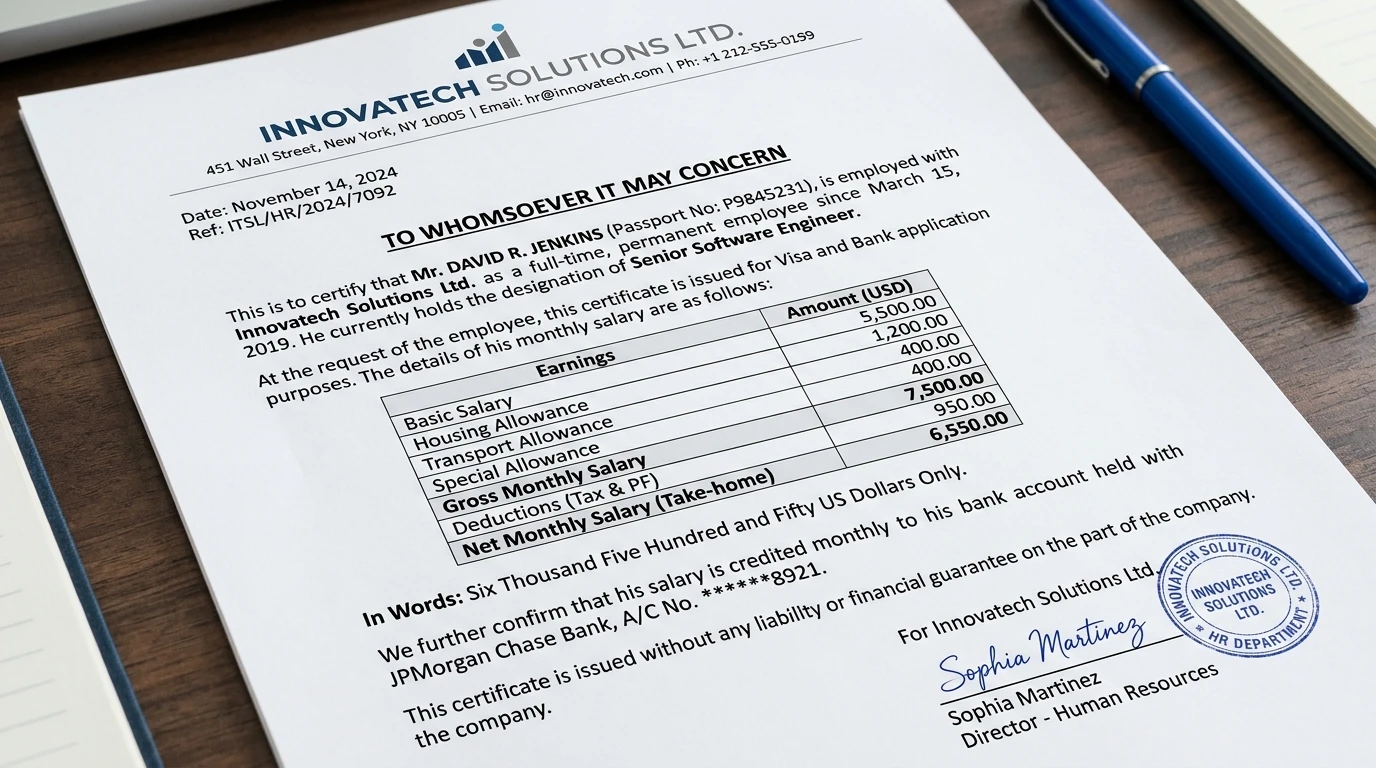
A salary certificate UAE employers issue is a signed letter on company letterhead confirming your job title, joining date and monthly salary. Banks use it for accounts, loans and cards, and immigration offices use it to check income for family visa sponsorship. Many banks want one issued within 30 days.
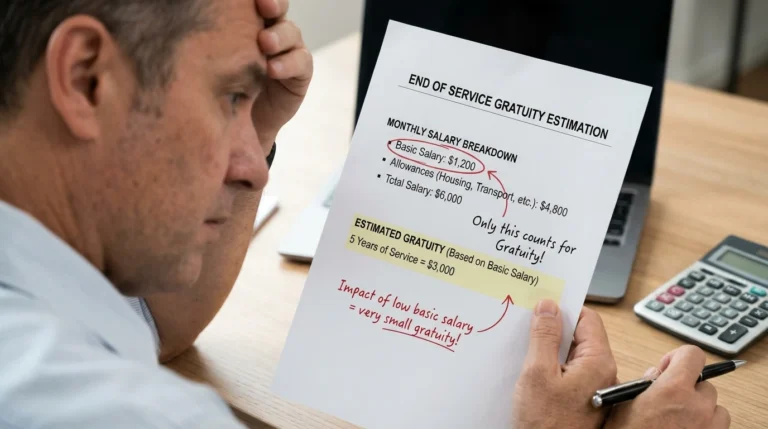
The salary breakdown on the letter also matters for your end-of-service payout, because gratuity under Article 51 is calculated on basic salary only. This guide covers what the certificate must contain, a sample format, what banks and visa offices check, and what to do if your employer delays or refuses.
Salary certificate versus other employer documents
People often ask for the wrong letter. The table separates the common ones:
| Document | What it does | When you get it |
| Salary certificate | Confirms your current job and monthly salary to a third party | On request while employed |
| Salary transfer letter | Confirms salary is paid into a named bank account, often for a loan | On request, usually for a bank |
| Payslip | Records one month’s pay and deductions | Each pay period |
| Experience certificate | Confirms past employment, dates and job title | At the end of the contract, free of charge (Article 13) |
| No Objection Certificate (NOC) | Gives your employer’s consent for a stated purpose | On request for that purpose |
What a salary certificate must contain
There is no single legal template, but banks and visa offices look for the same items:
- Company details: name, address and contact details on letterhead, and often the trade licence number.
- Date of issue and addressee: either “To Whom It May Concern” or a named bank.
- Employee details: full name, passport or Emirates ID number, job title and date of joining.
- Salary breakdown: basic salary, each allowance and the total monthly salary.
- Employment status: a statement that you are currently employed.
- Purpose: for example bank account opening, loan application or visa processing.
- Authorisation: the name, title and signature of an authorised signatory, plus the company stamp.
Sample salary certificate format
Use this layout as a starting point and adapt it to your company’s style:
| [Company letterhead, address and contact details] Date: DD/MM/YYYY To: [Bank name] / To whom it may concern Subject: Salary certificate This is to certify that [Full name], passport number [number] and Emirates ID [number], has been employed by [Company name] as [Job title] since [date of joining] and remains in our employment. Monthly salary: Basic AED [amount]; Housing AED [amount]; Transport AED [amount]; Other AED [amount]; Total AED [amount]. The salary is paid through the Wage Protection System. This certificate is issued at the employee’s request for [purpose] and without any liability on the part of the company. [Authorised signatory name, title, signature and company stamp] |
Salary certificate for a bank
Banks use the certificate to confirm that your employer, your job and your pay match what you told them. Practice varies by bank, but guides commonly cite three points: the letter is recent, it names the bank, and it confirms that salary is paid through the Wage Protection System. Some lenders also ask for a salary transfer letter. Check the requirement with your bank before you ask HR.
Banks often cross-check the letter against your bank statements, so the figure must match what actually reaches your account. A certificate that shows a higher salary than your payroll is a fraud risk for you and your employer.
Think before you borrow against your pay. A bank may claim or freeze gratuity to recover a personal loan, as explained in how banks can freeze gratuity after a loan default.
Salary certificate for a visa
The most common visa use is family sponsorship. The UAE government portal sets the minimum salary to sponsor a spouse or children at AED 4,000 a month, or AED 3,000 plus accommodation. ICP and GDRFA ask for proof of income, usually a salary certificate or your employment contract.
The certificate should match the contract registered with MOHRE, because mismatches are a common cause of rejection. The government wording refers to salary without saying whether allowances count. If your total package clears AED 4,000 but your basic salary does not, confirm with ICP or GDRFA before you apply. The labour card guide explains how your MOHRE contract is recorded.
For embassy visas and tourist visa applications abroad, requirements vary by country. Ask the receiving embassy whether it wants a recent certificate, attestation or a translation.
Can your employer refuse to issue one?
Legal commentary is split. Some guides say an employer cannot refuse a reasonable request, while others note that Federal Decree-Law No. 33 of 2021 has no standalone provision requiring a salary certificate. Issuing one is standard HR practice, and refusing without a reason can lead to a labour complaint. The experience certificate is different. Article 13 requires the employer to provide it free of charge when the contract ends, and MOHRE says there is no minimum service period. If an employer refuses, you can file a MOHRE complaint.
How to request one, step by step
- Email HR with the details. State the purpose, the addressee and how many copies you need.
- Ask for the full breakdown. Request basic salary and each allowance, not only the total.
- Check every figure. Compare the amounts, your job title and your joining date with your contract and payslips.
- Confirm the date. Ask for a fresh issue date if your institution wants a recent letter.
- Keep a copy. Save a scan with the original, because some applications need both.
- Ask before your last day. A salary certificate certifies current income, so request any you need while still employed.
Mistakes that cause rejection
- An old issue date, when the bank or visa office wants a recent one.
- A missing signature or company stamp.
- No salary breakdown, only a total.
- Figures that do not match the MOHRE contract, payslips or bank statements.
- The wrong addressee, when a bank asks for a letter in its own name.
- No stated purpose.
How the certificate connects to your gratuity
The basic salary on the certificate is the figure that drives gratuity. For example, a certificate showing AED 6,000 basic and AED 9,000 total gives gratuity of 6,000 ÷ 30 × 21 × 5 = AED 21,000 after five years, not a figure based on the AED 9,000 total. If the certificate shows a basic that is lower than your contract, you may lose out later. Check the breakdown against your contract, and see common gratuity calculation mistakes for the errors that follow.
Keep your certificates and payslips. They help you verify a final settlement, and the final settlement calculator can check what you are owed when you leave.
Edge cases
- Salary changes: a raise, cut or new allowance makes an older certificate out of date, so request a new one.
- Free zone employees: the certificate usually refers to the free zone authority’s licence, not a mainland trade licence.
- Probation: some banks ask for a longer service history, so a certificate alone may not be enough.
- Leaving the job: a salary certificate is not issued for past employment, so use an experience certificate instead.