DMCC Final Settlement Disputes: What You Are Owed and How to Challenge Deductions
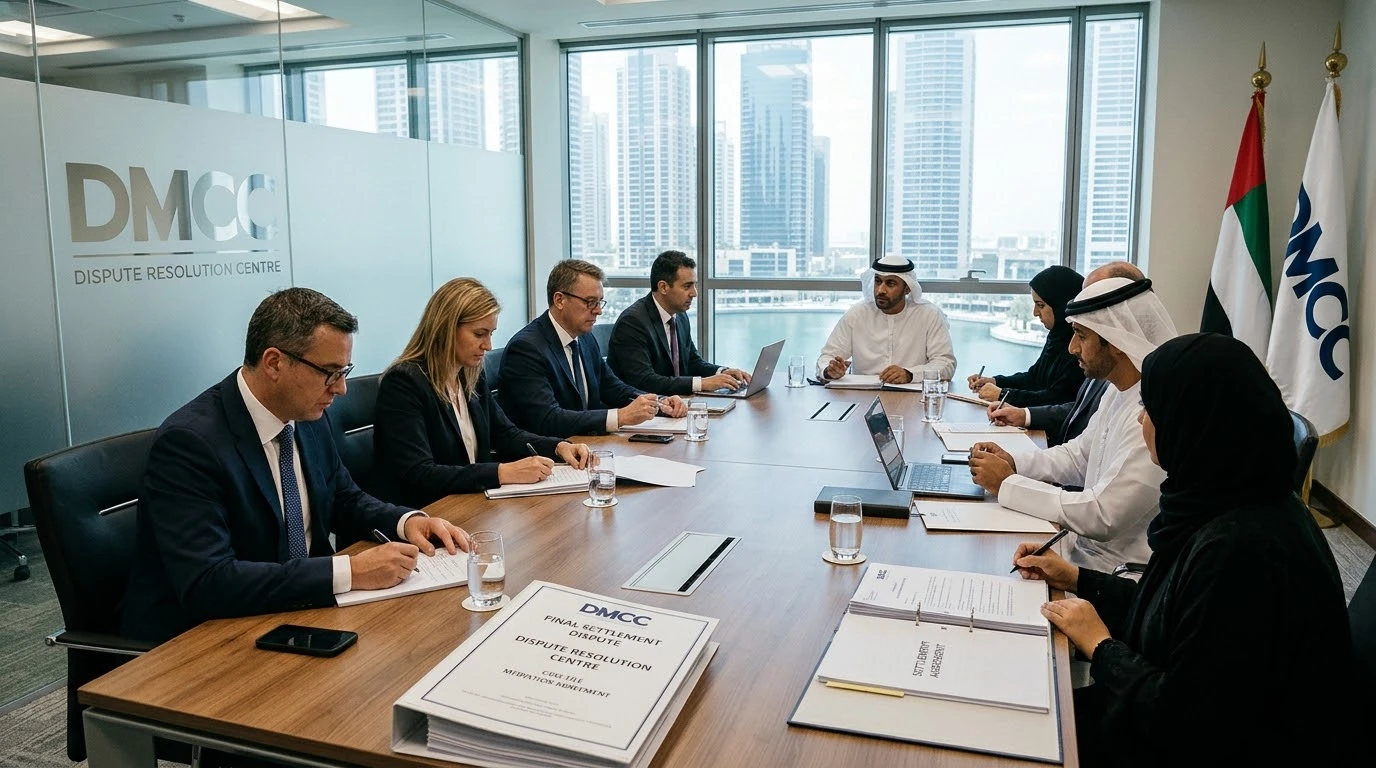
Your DMCC final settlement is governed by federal UAE labour law, and your employer must pay all dues within 14 days of your contract ending. These include wages, unused leave, gratuity after one year of service and any repatriation owed. If dues are late or deductions are unexplained, you can use DMCC mediation or file a claim with MOHRE.
This guide is for employees of companies licensed by DMCC, one of Dubai’s free zones. Many other free zones also apply federal law, but DIFC and ADGM run their own employment regimes, which we cover in our guide to DIFC and ADGM gratuity rules. Domestic workers fall under a separate law.
Which Law Applies to a DMCC Final Settlement?
A DMCC employer must follow Federal Decree-Law No. 33 of 2021 and its implementing regulations, Cabinet Resolution No. 1 of 2022. That is the same labour law that covers mainland companies. DMCC has no separate gratuity code. Working in a free zone changes where you take a dispute, not what you are owed.
Free zone calculation guides are useful samples, but they are not binding formulas. A Labour Court may read the rules differently, so rely on the law and your contract first.
What a DMCC Final Settlement Must Include
Your employer must pay everything you have earned and are owed within 14 days of the contract ending, under Article 53. The table shows the usual components.
| Component | Rule | Legal basis |
| Wages up to your last day | Paid in full, including any unpaid days in the final month | Article 53 |
| Unused annual leave | Paid on basic salary; statutory accrual starts after six months of service | Article 29 |
| End-of-service gratuity | Full-time expatriates with at least one year of continuous service; based on basic salary | Article 51(2) |
| Notice pay | Due if the employer ended your job without the required notice | Labour law notice rules |
| Repatriation | Employer bears the cost to your point of hire unless you join another employer or the contract ends for reasons due to you | Article 13(12) |
| Experience certificate | Free on request, stating your service dates, job title and last wage | Article 13(11) |
Run your own figures through our dues calculator before you accept any amount.
How Gratuity Is Calculated
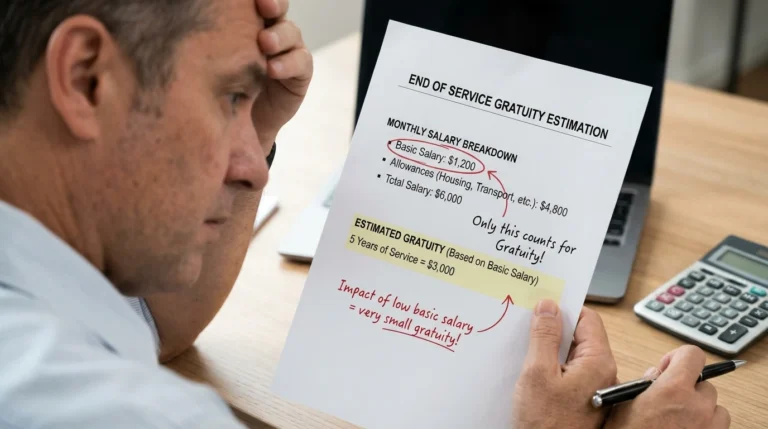
Gratuity uses your last basic salary, not your total pay, so allowances are excluded. You earn 21 days of basic salary for each of the first five years and 30 days for each year after that. After the first year, part years count proportionately. Days of unpaid leave do not count as service under Article 51(4), and total gratuity cannot exceed two years’ wage. Resignation no longer reduces it.
Calculators differ on the daily rate. Some divide monthly basic salary by 30, while others divide annual basic salary by 365. On a larger settlement the gap can reach a few hundred dirhams. It is a method difference, not a deduction, but you should ask which method your employer used.
Common DMCC Final Settlement Disputes
Most disputes follow one of five patterns.
- Late payment. Wages and gratuity remain unpaid after the 14-day window that runs from the date the contract ends.
- The wrong gratuity base. The employer uses a lower basic figure than your contract states. A salary reduction agreed shortly before you leave also lowers the base, so read any such agreement before signing.
- Missing leave pay. Accrued, unused leave is left out or paid at the wrong rate.
- Pressure to sign. Payment is held back until you sign a clearance or “full and final” form.
- Unexplained deductions. The statement shows lump-sum charges with no explanation or paperwork.
Unexplained Deductions in a DMCC Final Settlement
A deduction is lawful only if it fits a category in the labour law and the employer can document it. Article 25 sets these limits for deductions from wages.
| Deduction | Limit | Condition |
| Loan repayment | No interest; within the overall cap | Your written consent |
| Overpayment recovery | Up to 20% of wage | A real overpayment |
| Penalty for a violation | Up to 5% of wage | Under a Ministry-approved penalties list |
| Court-ordered debt | Up to one quarter of wage (alimony excepted) | A court judgment |
| Damage to employer property | Up to five days’ wage per month | Caused by your error or breach of instructions; more needs court approval |
| All deductions together | Up to 50% of wage | Article 25(2) |
Recruitment, visa, medical and vague “administrative” charges are not on this list, and employers cannot recover visa-related costs from employees. Deductions from end-of-service dues must also fit a legal category and be backed by documents, such as a signed loan agreement or a court order. An employer can claim compensation equal to your wages for notice you failed to serve, but not if you served it.
A bank is different. It may freeze or claim gratuity for an unpaid personal loan under your loan contract, and that claim does not come from the labour law.
Worked Example
These figures are illustrations. The rates and rules are legal; the salary and deduction amounts are assumed.
An employee earns AED 8,000 basic plus AED 4,000 allowances (AED 12,000 total) and leaves after six years and three months. Wages are unpaid for the last 20 days, and 12 days of leave remain unused.
- Unpaid wages: AED 12,000 ÷ 30 × 20 = AED 8,000
- Leave on basic salary: AED 8,000 ÷ 30 × 12 = AED 3,200
- Gratuity days: (5 × 21) + (1.25 × 30) = 142.5 days
- Gratuity: AED 8,000 ÷ 30 × 142.5 = AED 38,000
- Total due: AED 49,200
The employer’s statement deducts AED 1,000 for a salary advance covered by a signed agreement, AED 1,500 for “visa cancellation cost” and AED 2,500 for “admin and notice recovery”, although the employee served full notice. It offers AED 44,200.
Only the AED 1,000 advance has a lawful basis. The employee should claim AED 4,000 more, which brings the payment to AED 48,200. If the employer divided annual basic salary by 365 instead, gratuity would be AED 37,479.45, about AED 520 lower. That gap is a method difference, not an unexplained deduction.
How to Raise a DMCC Final Settlement Dispute
A free zone dispute has one extra stage compared with a mainland case. Take the steps in this order.
- Ask HR for a written breakdown that lists every component and the basis of each deduction. Do not sign a statement saying you received everything unless you have.
- Send a written demand with a deadline. Our sample gratuity claim letter gives you wording to adapt.
- Request DMCC workplace mediation. Employees submit a request through a case on the DMCC Help Centre. At the time of writing, DMCC lists a non-refundable filing fee of AED 205 plus Knowledge and Innovation fees, excluding VAT, so confirm the current amount. Mediation is voluntary, and either side can withdraw.
- If the dispute does not settle, ask DMCC for a no-objection certificate (NOC). DMCC issues it after three business days. It expires if you do not register your case within 14 calendar days. DMCC issues up to two NOCs per dispute, and the second costs AED 420.
- File with MOHRE online, through the MOHRE app or via the Labour Claims and Advisory call centre on 80084. DMCC treats mediation as optional and says either party may go to the Ministry of Labour directly, but MOHRE may ask free zone workers for proof they tried the free zone route first, so confirm before filing. Our step-by-step MOHRE complaint guide covers the filing screens.
- Watch the deadlines. You have two years from the end of employment to bring a claim under Article 54(9). MOHRE can issue a binding decision on claims up to AED 50,000. Larger claims, and free zone cases that stay unresolved, go to the Labour Court on a no-objection certificate, and court filings must be in Arabic.
Edge Cases to Check
Your employer joined the savings scheme. Some employers have moved to the voluntary end-of-service savings scheme. Gratuity earned up to the changeover date is calculated on your basic salary on that date and still paid when you leave, together with the scheme payout. Ask HR whether your company joined.
You served less than one year. No gratuity is due, but wages, leave under the six-month rule, repatriation and any notice pay remain payable.
You resigned. Resignation does not cut gratuity under the 2021 law. An employer cannot withhold it only because you resigned or the working relationship was poor.