Low Basic Salary and Gratuity in the UAE: How Your Salary Structure Cuts Your Payout
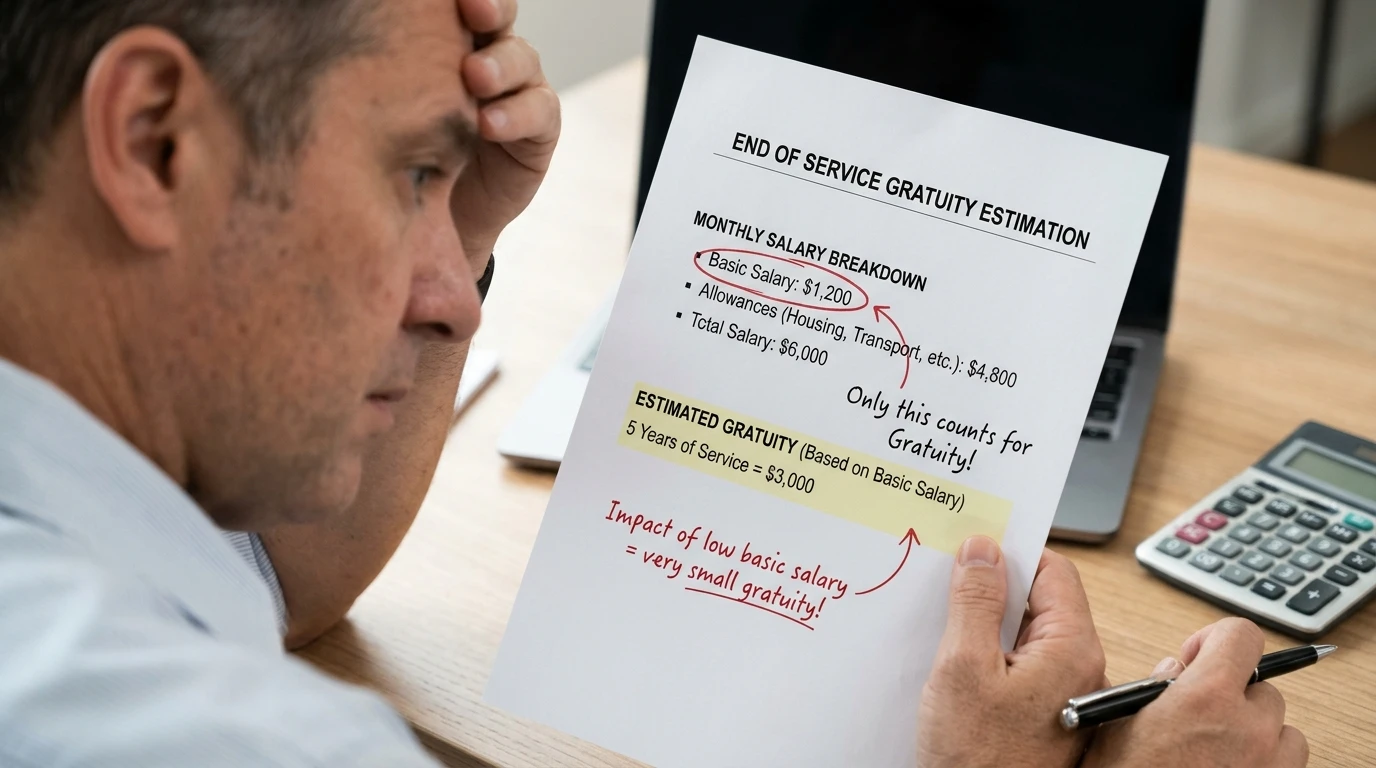
Low basic salary gratuity means a smaller end-of-service payout, because Article 51 calculates gratuity on your last basic wage and excludes allowances. A package of AED 10,000 with a AED 4,000 basic pays far less gratuity than one with a AED 7,000 basic. The law sets no minimum basic share.
Two people on the same total package can leave the same job with very different payouts. This guide shows how the salary structure drives the gratuity calculation, what a low basic costs in real numbers, when employers can and cannot change it, and what you can do about it.
Why basic salary drives your gratuity
Article 51 of Federal Decree-Law No. 33 of 2021 bases gratuity on the last basic wage the worker was entitled to. The law defines the basic wage as the wage stated in the employment contract for the work, without allowances or benefits in kind. The UAE government portal confirms that housing, transport, utilities and furniture allowances are not counted.
The formula is 21 days of basic wage for each of the first five years and 30 days for each year after that, once you complete one year of continuous service. A part-year is paid proportionally, and the total cannot exceed two years’ wage. With a low basic, the cap is rarely a concern. The daily rate is the problem.
What a low basic costs: a worked example
Take two illustrative employees on the same AED 12,000 monthly package. One has a basic of AED 8,000, the other AED 4,000. The daily basic wage is the basic salary divided by 30.
| Item | Employee A | Employee B | Difference |
| Total package | AED 12,000 | AED 12,000 | None |
| Basic / allowances | 8,000 / 4,000 | 4,000 / 8,000 | — |
| Daily basic wage | AED 266.67 | AED 133.33 | AED 133.33 |
| Gratuity after 5 years (105 days) | AED 28,000 | AED 14,000 | AED 14,000 |
| Gratuity after 10 years (255 days) | AED 68,000 | AED 34,000 | AED 34,000 |
The five-year figure is 21 × 5 = 105 days. The ten-year figure is 105 days plus 30 × 5 = 150 days, which gives 255 days. Halving the basic halves the gratuity, and the gap widens every year. The total package was identical throughout.
What else a low basic reduces
Gratuity is not the only entitlement tied to the basic salary. The table shows which parts of your final settlement move with it.
| Entitlement | Calculated on | Effect of a low basic |
| Gratuity (Article 51) | Last basic wage | Lower directly |
| Unused annual leave | Basic salary | Lower daily rate |
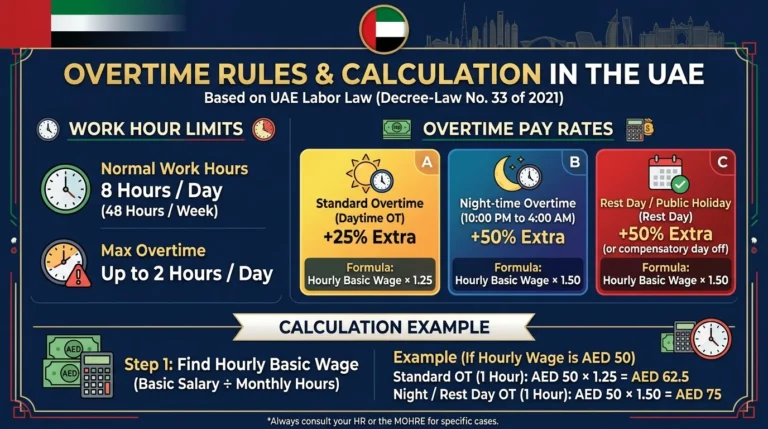
| Overtime | Basic hourly wage plus 25% or 50% | Lower hourly rate |
| Notice pay | Commonly the full wage | Largely unaffected |
| Unpaid salary | Full wage | Unaffected |
Is a low basic salary legal?
Yes, in principle. The law does not set a minimum share for the basic salary, and the split between basic and allowances is left to the contract. The National’s adviser says it should still be reasonable and justifiable, and cites a general expectation that basic should not fall below 60% of the package. Other advisers describe a typical range of 40% to 60%. None of these figures is a legal rule.
The line to watch is intent. HR advisers describe an artificially suppressed basic, set low only to shrink gratuity liability, as a point MOHRE can scrutinise, and one that gives employees grounds to contest the structure. A low basic written into the contract at the start is generally treated differently from a figure invented at exit.
Check which document governs. The contract registered with MOHRE is the binding one, so a basic salary shown on your offer letter but reduced on the MOHRE contract can cost you years later. Some advisers also say that where a contract does not split the wage at all, the whole wage is treated as basic. Confirm that point with MOHRE before relying on it.
Can your employer cut your basic salary?
Not unilaterally. The National’s adviser says a basic salary cut is a change of contract terms, and an employer cannot simply reduce it or alter other agreed conditions arbitrarily.
The risk comes from signing. Ahmed Odeh of MIO & Partners told Gulf News that if the basic wage is validly reduced before termination, the gratuity calculation may fall with it. He adds that an employee may have grounds to challenge a reduction imposed as a device to defeat statutory entitlements. Be cautious about any salary-reduction addendum near the end of employment, and keep a copy of everything you sign.
How to check your own salary structure
- Find your MOHRE-registered contract. It states the agreed wage and its components. This is your basic salary reference.
- Compare it with your payslips. The basic line should match the contract. If it has dropped, ask for the signed amendment.
- Recalculate your gratuity on basic only. Divide the basic by 30, multiply by 21 for each of the first five years and by 30 after that. The final settlement calculator does the arithmetic for the whole package.
- Look for errors in the employer’s figure. Using the wrong salary base is one of the most common slips, covered in common gratuity calculation mistakes.
- Get the structure in writing for any new job. Ask for the basic figure, not only the total package, before you accept, and check that the MOHRE contract matches the offer letter.
Example: a mismatch between the offer letter and the contract
Suppose an offer letter promises a basic salary of AED 9,000 within a AED 15,000 package, but the MOHRE-registered contract shows a basic of AED 6,000 and AED 9,000 in allowances. After six years, the gratuity period is 21 × 5 + 30 = 135 days. On the offer letter figure the gratuity is 9,000 ÷ 30 × 135 = AED 40,500. On the registered contract it is 6,000 ÷ 30 × 135 = AED 27,000. The AED 13,500 gap appears only when you leave, which is why you should compare the two documents on the first day.
What you can do if your basic is low
Negotiate the structure at the offer or renewal stage, when your position is strongest. Even a modest increase in the basic share raises gratuity, leave pay and overtime together. Our guide to ways to increase your gratuity covers negotiation points in more detail.
If your employer offers the optional savings scheme, remember it also works from the basic wage. Reports put the employer contribution at 5.83% of monthly basic wage for the first five years and 8.33% after that, so a low basic lowers the contribution as well. See the end-of-service savings scheme guide before agreeing to switch.
If you believe the structure was changed to defeat your entitlements, document the timeline and raise it with HR in writing. If the issue remains unresolved, you can file a MOHRE complaint. Remember that claims must be brought within two years of the end of employment.
Edge cases
- Commission and bonuses: these are not basic wage, so they do not raise gratuity. They may still be due as separate contractual dues in your final settlement.
- Part-time work: gratuity is pro-rated by contracted hours against full-time hours, applied to the basic wage.
- Less than one year of service: no gratuity is payable whatever the basic salary.
- DIFC and ADGM: these systems follow their own rules and savings schemes, so the mainland formula above does not apply.