Overtime Rules and Calculation in the UAE (2026): Rates, Limits and Examples
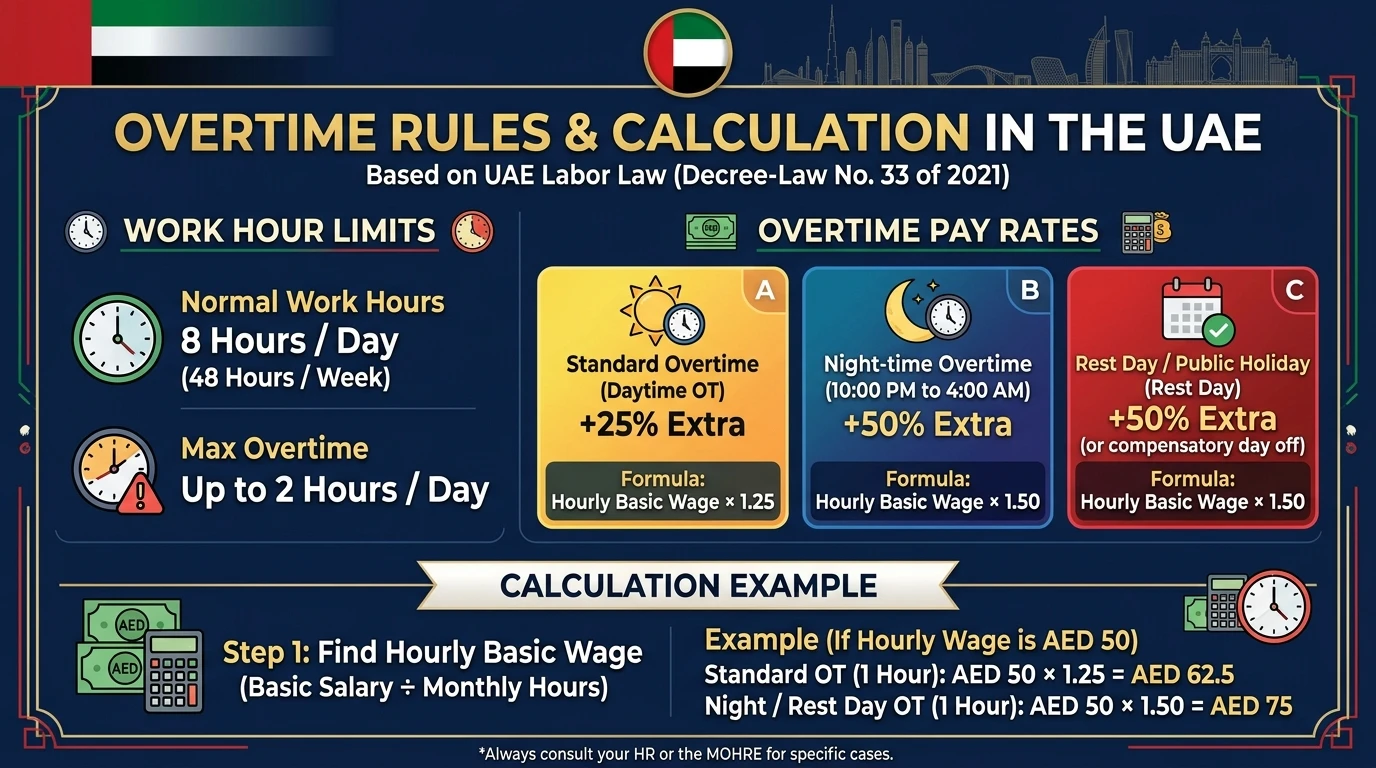
The overtime rules UAE employers must follow are simple at heart. Normal hours are eight a day or 48 a week. Extra hours earn at least 125% of your hourly basic rate, or 150% between 10pm and 4am. Overtime is capped at two hours a day, and work on rest days or public holidays has its own premium.
This guide covers private-sector employees on the mainland under Federal Decree-Law No. 33 of 2021 and its executive regulations. Domestic workers fall under a separate law, and DIFC and ADGM run their own employment regimes.
What Counts as Overtime
Under Article 17, normal working time is a maximum of eight hours a day or 48 hours a week. Any time you work beyond your normal hours at your employer’s request is overtime. Your contract or your employer’s policy may set shorter normal hours, so check your own terms first.
Time spent on a break does not count as working time. Hours you choose to stay late, with no request from your employer, are harder to claim, so keep any instruction to stay in writing.
Limits on Overtime Hours
Article 19 lets an employer ask you to work extra hours, but only within set limits.
- Daily limit: overtime cannot exceed two hours a day. Going beyond that needs conditions set by the executive regulations, and those exceptions are narrow.
- Three-week ceiling: total working hours cannot exceed 144 in three weeks, whatever the circumstances.
Regular long shifts do not become lawful because the employer pays for them. If your hours keep passing these limits, that is a matter for MOHRE as well as a pay issue.
Overtime Rates: 125%, 150% and Other Premiums
Pay is worked out from your basic wage, not your total package. The table shows each rate and when it applies.
| Situation | Minimum pay | Notes |
| Ordinary overtime (daytime) | 125% of the hourly basic rate | Normal rate plus at least 25% |
| Overtime between 10pm and 4am | 150% of the hourly basic rate | Normal rate plus at least 50%; does not apply to shift workers |
| Work on your weekly rest day | A substitute day, or the normal day’s pay plus 50% | The employer chooses; you cannot demand both |
| Work on a public holiday | A substitute day, or the normal day’s pay plus at least 50% | Article 28 covers holiday work |
Rest-day and holiday work follow different rules from ordinary overtime, so our guide to working on public holidays goes into the substitute-day option and what a fair payment looks like.
How to Calculate Overtime Pay
Use this method for hourly pay. Basic salary means the fixed wage in your contract before allowances.
- Find the daily rate. Divide monthly basic salary by 30.
- Find the hourly rate. Divide the daily rate by your normal daily hours, usually eight.
- Apply the premium. Multiply the hourly rate by 1.25 for ordinary overtime or 1.5 for night overtime.
- Multiply by the hours worked. Add up each type of overtime separately.
Some employers divide by 26 working days instead of 30. Using 30 follows the common reading of the law, so ask your employer to show the divisor in writing if the figures look low.
Worked Example
These figures are illustrations. The rates are legal; the salary and hours are assumed.
A sales coordinator earns AED 6,000 basic salary and AED 9,000 in total pay. In one month, she works 10 evenings with two extra hours each, one night session of four hours after 10pm, and one full day on a public holiday with no substitute day.
- Hourly rate: AED 6,000 ÷ 30 ÷ 8 = AED 25.00
- Ordinary overtime: AED 25.00 × 1.25 = AED 31.25 an hour; 20 hours × AED 31.25 = AED 625.00
- Night overtime: AED 25.00 × 1.5 = AED 37.50 an hour; 4 hours × AED 37.50 = AED 150.00
- Public holiday: AED 6,000 ÷ 30 = AED 200 a day; AED 200 × 1.5 = AED 300.00
- Total overtime for the month: AED 1,075.00
The AED 3,000 of allowances plays no part in the hourly rate. Some payslips already include the ordinary day’s pay for a holiday, so check whether the AED 300 is the full holiday payment or only the premium on top.
To test your own month, run the figures in our overtime tool and compare the result with your payslip.
Who Is Not Entitled to Overtime
Cabinet Resolution No. 1 of 2022 excludes supervisory staff who hold the employer’s own powers. The test is the real authority you hold, not your job title. A manager who can hire, discipline and approve spending is in a different position from a “supervisor” who only passes tasks on.
Shift workers cannot claim the extra 50% night premium, because night work is part of their normal pattern. They still earn overtime for hours beyond their scheduled shift.
Employees in DIFC are in a different position. The DIFC employment law sets no fixed overtime premium, so pay depends on the contract. Our page for DIFC and ADGM employees explains how those regimes differ.
Overtime During Ramadan
Private-sector daily hours are reduced by two during Ramadan. Work beyond the shortened day counts as overtime. For example, if your normal day is eight hours, you work six in Ramadan, and an eight-hour day then includes two hours of overtime at 125%.
Overtime and Your Gratuity
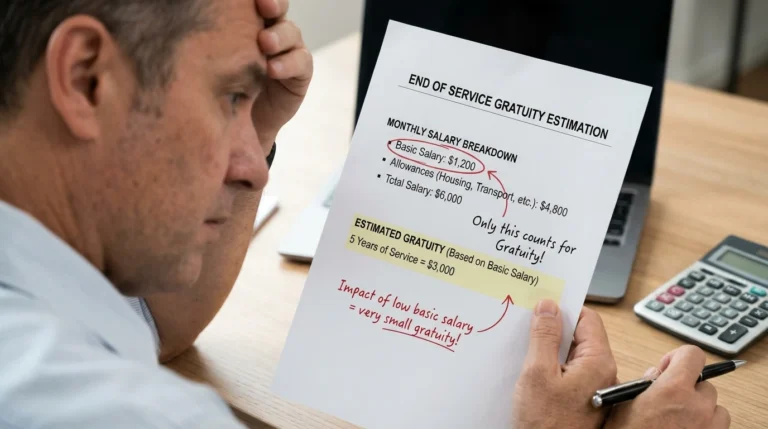
Under Article 51(2), gratuity is based on basic salary. Overtime is not part of basic salary, so it does not raise your gratuity, even if you work it every month. Mixing the two is a frequent error, and common slips in end-of-service sums lists others to avoid.
Proof and Records
Overtime claims fail most often for lack of proof. Keep the following from the start.
- A personal log of dates, start and finish times and what you worked on.
- Emails or messages where your manager asks you to stay late or work on a day off.
- Access-card, biometric or system log-in records, if you can obtain them.
- Payslips and bank statements that show what was and was not paid.
Salary paid through the Wage Protection System leaves a clear record, so any shortfall in overtime pay shows against your payslip.
How to Claim Unpaid Overtime
- Raise it in writing. Send your employer a dated email listing the dates, hours and amount you claim.
- Give a reasonable deadline. Ten working days is a common choice.
- File with MOHRE. If there is no reply, register a complaint through the MOHRE app, website or call centre, and attach your records.
- Go to court if needed. Unresolved claims, or claims above AED 50,000, move to the labour court.
Act early. Article 54, as amended in 2024, sets a two-year limit for labour claims. Do not wait until your last day if you suspect a shortfall, because records are easier to gather while you still work there.
Common Mistakes
- Using total salary for the hourly rate. The law uses basic wage.
- Treating a long day as automatic overtime. Check your contractual hours first.
- Assuming a fixed salary covers everything. The law sets minimums, and a contract cannot reduce them.
- Skipping written proof. A verbal request to stay late is hard to prove.
- Confusing rest days and holidays with ordinary overtime. Each has its own payment rule.
Key Takeaways
- Normal hours are eight a day or 48 a week; time beyond that, requested by your employer, is overtime.
- Ordinary overtime pays at least 125% of the hourly basic rate, and night overtime from 10pm to 4am pays at least 150%.
- Overtime is capped at two hours a day, within a 144-hour ceiling over three weeks.
- Hourly rate = monthly basic salary ÷ 30 ÷ 8.
- Supervisors with the employer’s powers and, for the night premium, shift workers are excluded.
- Overtime does not count towards gratuity; keep records and claim within two years.
This guide gives general information for private-sector employees and is not legal advice.